Patient Story - Al Lewis
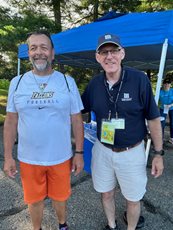 In May 2025, Albert “Al” Lewis experienced a heart attack. He told his wife, Marla, he was not feeling well and just needed to sit by a window and breathe in the fresh air. He and Marla were preparing to leave the house for a visit with their son in Columbus. As Marla completed her preparations, Al tried to relax and determine exactly why he did not feel quite like himself.
“There was not a feeling of pressure or pain in my chest,” Al said. “I just felt a bit off. I was unsure what was happening, and I did not want to alarm my family.”
When Marla returned to check on Al, she asked if he was feeling any better. When he said no, she asked if he thought he should go to the Emergency Department (ED) at Licking Memorial Hospital (LMH). Al agreed it might be wise to have a physician determine the cause of his sudden weakness. They got into their car and Marla began driving to LMH while trying to watch Al. He said he felt lightheaded, and then he slumped over in his seat.
“I yelled his name and pushed on his arm,” said Marla, “But there was no response. I was panicked. When I arrived at LMH, I stopped in front of the ED doors and ran in screaming for help. A nurse ran out and pulled Al from the car, placed him on the ground, and started performing CPR. That is when I was told he had no pulse. His heart stopped on the drive to the Hospital.”
LMH has a designated team of healthcare professionals specifically trained to respond when a patient is experiencing a life-threatening event such as a heart attack. A code blue is activated and the medical emergency is announced over the public address system. The team members quickly access the patient and take action. In Al’s case, he was taken to the Cardiac Catheterization Laboratory, a special operating room equipped with the technology to perform heart procedures such as opening clogged arteries and placing stents.
“I was told they worked for 22 minutes to restart Al’s heart,” Marla remembers. “They had to use a defibrillator to shock him twice. He became responsive five hours later and by eight the next morning he was awake, taken off the ventilator, and talking. The entire team was just amazing.”
During the catheterization procedure, Hassan Rajjoub, M.D., found a 100 percent blockage in the largest artery in the heart which is often referred to as a widow-maker heart attack. According to the American Heart Association, the survival rate following a widow-maker heart attack is only 12 percent when it occurs outside of a hospital or advanced care center. Al spent eight days at LMH. During that time, the team from the Cath Lab and ED stopped by his room to check on his progress and make sure he was recovering fully.
“Everyone was so kind and hospitable, allowing my family to completely take over the waiting room during the procedure,” Marla shared. “We felt so supported and comforted by their presence. Dr. Rajjoub spoke to us and assured us he had done all he could to re-open the artery and the remainder of the recovery was up to Al.”
Al and Marla have five adult children and 10 grandchildren. They are excited for the arrival of two more grandchildren and a great-grandchild. The couple owns a tire shop in Newark. Al was able to return to work and participate in cardiac rehabilitation at LMH in the days following the procedure. In July, Al and Marla registered for Licking Memorial Health Systems’ “For Your Health” 5K Run/Walk & 1-mile Fun Walk at The Dawes Arboretum and walked the 5K course.
As Al continues to recover, he has experienced a few other concerns with his heart. He has an enlarged aorta and was also experiencing an atrial flutter. He has visited Vascular Surgeon Mark T. DeFransco, D.O., and Electrophysiologist John J. Keller, M.D. Dr. Keller performed an ablation, a procedure using small burns on the heart cells to stop the fluttering. Since that procedure, Al has continued to do well. He and Marla make a point to visit the men and women who came to his rescue during his heart attack
bringing small tokens of appreciation such as cookies or donuts. The couple also enjoyed reconnecting with the team during the annual Interventional Cardiology Reunion held at LMH.
While Al survived the heart attack and is recovering well, it is important to note that anyone experiencing symptoms of a heart attack should call 911 immediately instead of trying to travel to a hospital by themselves. Area Emergency Medical Services (EMS) squads are equipped with electrocardiogram machines and defibrillators. The EMS crew communicates with LMH, and the Interventional Cardiology team is waiting when a patient arrives. The faster response to a heart attack saves precious heart tissue.
| Posted On : 2/9/2026 12:20:43 PM